|
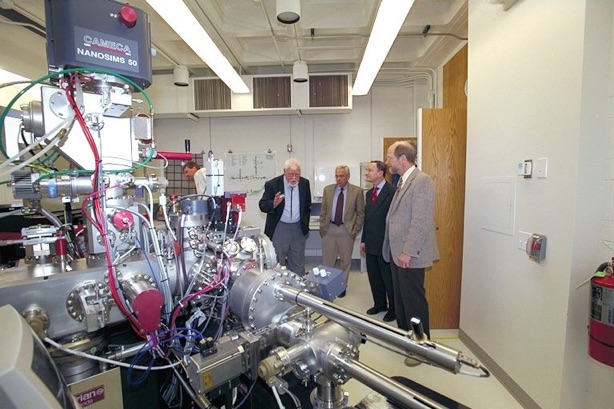
In the last
two years our work with the NanoSIMS has been very successful. The
downtime due to hardware problems went down dramatically and with the
help of our own development efforts, we are now able to use the
instrument for a large variety of scientific studies. Several
significant discoveries in the study of presolar grains and IDPs have
been made with the NanoSIMS in the short time this instrument has been
available. This has resulted in numerous publications from our group,
including four that were published in the journal Science (DAULTON et
al., 2002; FLOSS et al., 2004; MESSENGER et al., 2003a; NGUYEN and
ZINNER, 2004a).
Interplanetary
dust particles (IDPs) are primitive samples of extraterrestrial
material with a fine-grained heterogeneous matrix. We have used the
NanoSIMS for extensive studies of the C, N, O, Mg/Al, Si, and S
isotopic compositions of these particles on a sub-micrometer scale
(FLOSS and STADERMANN, 2003; 2004; FLOSS et al., 2004; MESSENGER and
KELLER, 2002; MESSENGER et al., 2003a; 2003b; STADERMANN and BRADLEY,
2003). This work led to the discovery of presolar silicates (MESSENGER
et al., 2003a) and the first observation of C isotopic anomalies in
these particles (FLOSS et al., 2004). Most recent results include the
discovery of presolar corundum in IDPs (in preparation) and of presolar
phases in Antarctic micrometeorites (in preparation).
Combined
mineralogical and isotopic studies of presolar grains on TEM grids were
used for the determination of SiC polytype distributions (DAULTON et
al., 2002; 2003) and for the detailed characterization of high-density
(CROAT et al., 2004; STADERMANN et al., 2004a) and low-density (CROAT
et al., 2003a; 2003b; STADERMANN et al., 2002; 2003; 2004b) presolar
graphite spherules and their sub-components. The latter project
included O and Ti isotopic measurements of 100 nm sized 'presolar
grains within presolar grains'.
Other lines
of investigation looked at the O isotopic compositions of presolar
spinel grains (ZINNER et al., 2002a; 2003b; 2004), as well as the C, N,
and Si isotopic compositions of small SiC and Si3N4 particles (ZINNER
et al., 2002b; 2003a). We used the multi-collection and combined mode
capabilities of the NanoSIMS for C, N, O, Mg/Al, Si, K, Ca, and Ti
isotopic studies of individual presolar graphites (AMARI et al., 2002;
2003a; 2004) and for C, Si, and Ti isotopic measurements in presolar
SiC grains of type X and Z (AMARI et al., 2003b).
High-resolution
NanoSIMS O isotopic imaging of >70,000 densely packed oxide grains
was used to identify several hundred presolar spinel and corundum
grains (NGUYEN et al., 2003a; 2003b; 2003c). A similar imaging study of
grain size separates from Acfer 094 led to the discovery of presolar
silicate stardust in meteorites (NGUYEN and ZINNER, 2004a; 2004b).
Some
development work using the St. Louis NanoSIMS has been done in
collaboration with CAMECA to quantify the aging characteristics of the
new miniaturized electron multipliers (SLODZIAN et al., 2003) and to
evaluate the 'QSA' effect (SLODZIAN et al., 2004). NanoSIMS imaging was
used for test measurements of elemental distributions in aerosol
particles (EBERT et al., 2004).
References for this
section
|